

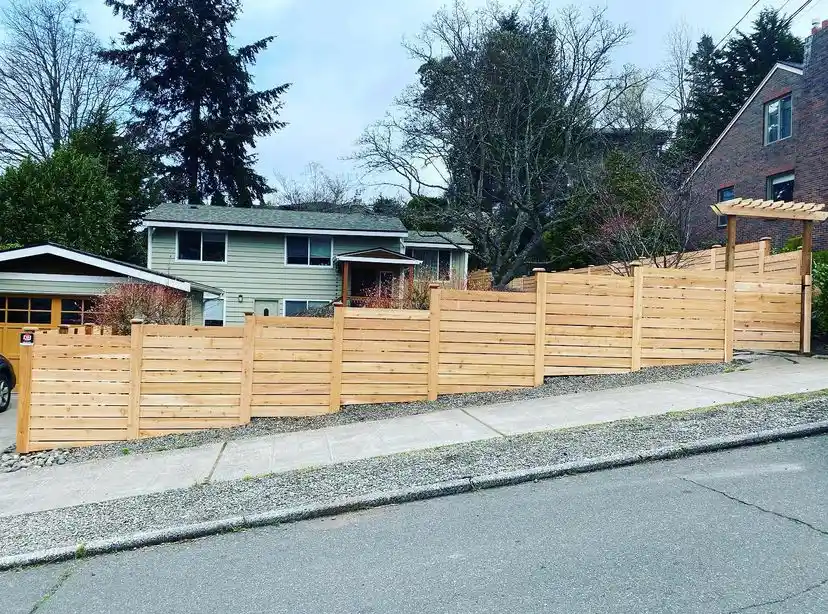
Horizontal cedar fences offer a modern aesthetic that visually expands compact urban lots while utilizing Western Red Cedar’s natural rot-resistant oils to withstand Seattle’s 156 annual rainy days. Unlike traditional vertical designs, horizontal boards demand precise craftsmanship—including tighter post spacing, inline mid-span backing, or internal metal frames—to prevent long-term board sagging or warping caused by Pacific Northwest moisture cycles. While standard residential installations up to 6 feet tall do not require an SDCI building permit, they must comply with strict local zoning laws that cap front setbacks at 4 feet, allow up to 2 additional feet for open architectural features like arbors, and permit height averaging up to 8 feet to gracefully navigate steep hillside grades.
Horizontal cedar fences give Seattle homes a clean, modern look with the natural warmth of cedar, delivering privacy, security, and curb appeal all at once. The parallel board lines feel current and calm, and they make smaller urban yards feel wider. Cedar earns its place here because it naturally resists rot and insects, which matters in a wet climate like ours.
But here’s the honest part. This fence style only lasts when it’s built right for the Pacific Northwest. If you’re a Seattle homeowner comparing fence styles before you request a free estimate, this guide walks you through why the modern look works here, what makes a cedar fence hold up in the rain, and what to check before anyone starts digging post holes.
What Is a Horizontal Cedar Fence?
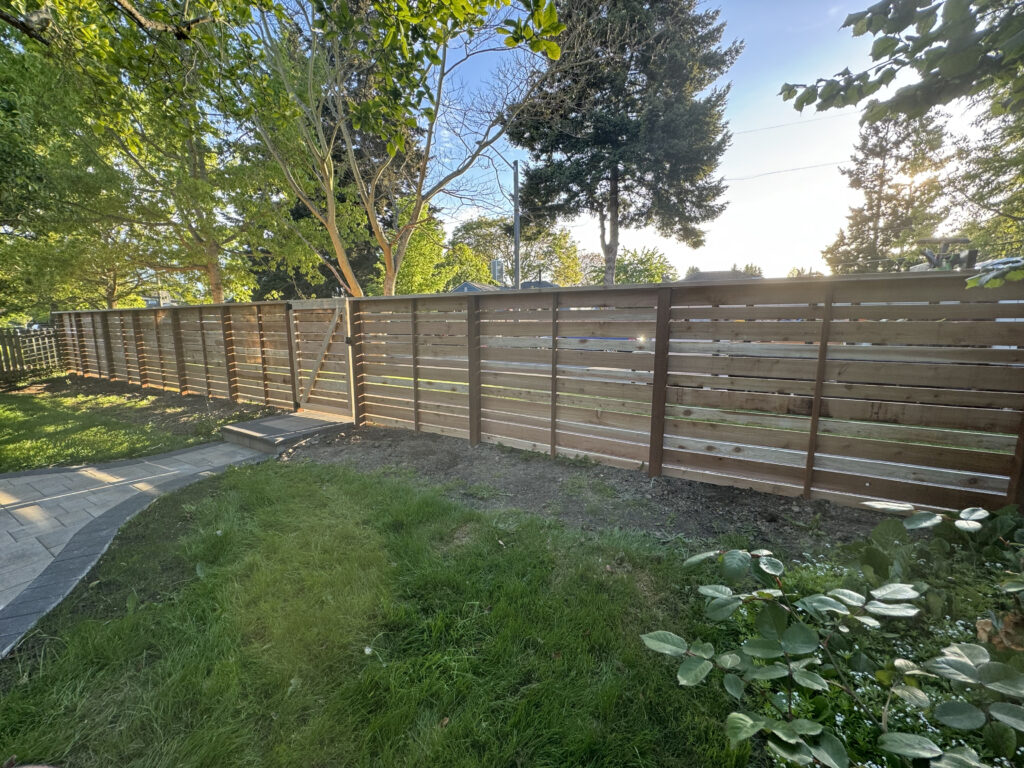
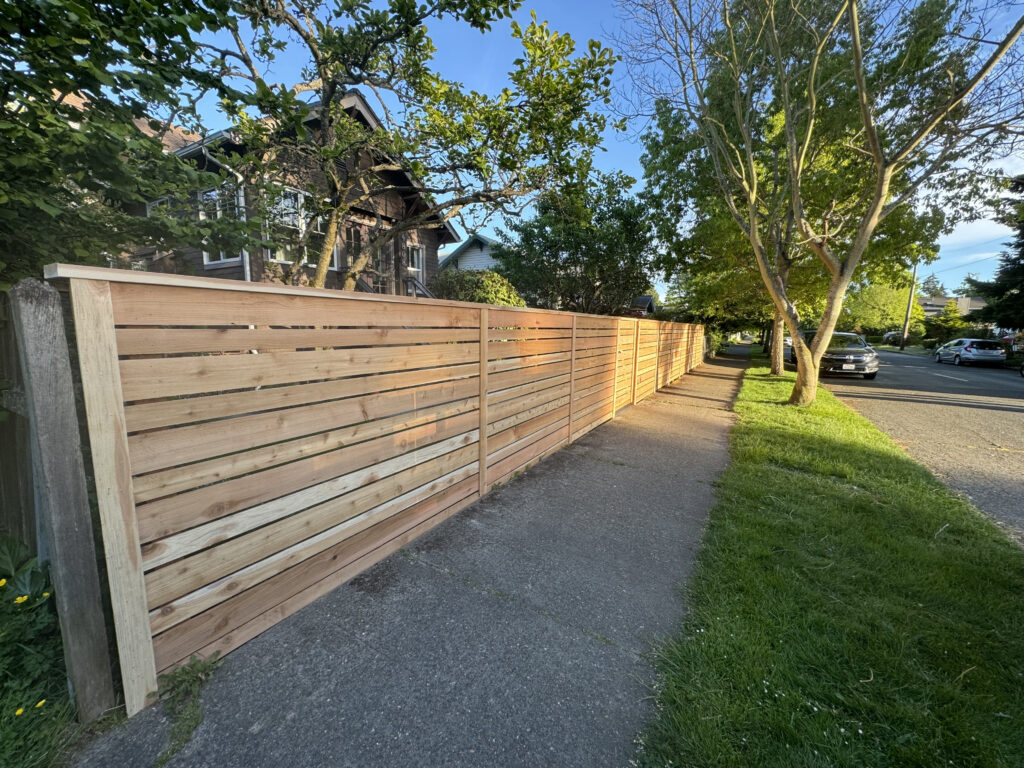
A horizontal cedar fence uses boards that run parallel to the ground, attached to posts and rails, instead of standing upright the way a traditional picket or board fence does. That single change in direction is what gives the fence its modern, open feel.
Cedar brings the warmth. The wood has soft color variations and a distinctive grain that reads as natural rather than manufactured, which is part of why it’s one of the most common fencing materials across the Pacific Northwest. When you pair that grain with long, low horizontal lines, you get a fence that looks designed rather than default.
The look is a design choice. The durability is a construction choice. Those are two different things, and both matter. If you want a full side-by-side of the two styles, that’s worth a dedicated read on horizontal versus vertical cedar fences.
Why the Modern Look Works So Well on Seattle Homes
Clean horizontal lines pull the eye sideways, which makes a yard feel wider than it is. On tight Seattle lots, that’s a real advantage. A vertical fence can feel like a wall closing in. A horizontal cedar fence feels like a frame that opens the space up.
The style is flexible, too. It suits modern builds and townhomes, but it also plays nicely with the Craftsman homes and remodels you see all over West Seattle and the Eastside. Cedar’s natural tone bridges old and new without clashing, and the same fence style can shift from rustic to sleek depending on the boards, the stain, and the spacing you choose. It reads well against almost any home’s architecture.
It also frames landscaping beautifully. Plantings, gravel beds, and raised gardens look sharper against horizontal cedar than against a busy vertical pattern. And a well-built cedar fence is a genuine curb appeal upgrade, the kind of detail buyers and neighbors notice. You get privacy, security, and curb appeal from one investment, which is exactly what most homeowners are after.
Why Cedar Is the Best Natural Wood for the Pacific Northwest
Western Red Cedar is a smart material selection for our climate, and there’s real science behind it. The Western Red Cedar Lumber Association notes that cedar’s fibers contain natural compounds that give the wood high natural resistance to moisture, decay, and insects. That’s the natural wood working for you before any finish is applied.
Cedar is also dimensionally stable. It has a low shrinkage factor and strong resistance to warping, twisting, and checking compared with other coniferous woods. For a horizontal wood fence, where long boards need to stay straight and level, that stability is a quiet advantage over other fencing materials.
Cedar is a renewable resource, which appeals to homeowners who care about where their materials come from. And with professional installation, a cedar fence can last 20 to 30 years, which makes it one of the best wood choices for a fence built to last around here. Its natural beauty is a bonus that holds up over time.
One thing we’ll always be straight about: cedar is not maintenance-free. The WRCLA points out that where wood sits in ground contact or stays wet for long periods, it needs suitable preservatives and smart detailing to prevent rot. Cedar gives you a durable head start. Good building and a little upkeep carry it the rest of the way.
The Seattle Weather Factor: Rain, Moisture, and Wind
Seattle’s climate brings steady rain, and a fence has to live with it. NOAA’s 1991 to 2020 climate normals put annual precipitation at the Seattle-Tacoma International Airport station at about 39.34 inches, though neighborhood microclimates vary quite a bit across the city. That’s a lot of moisture cycling through your fence every year, and this rainy climate is exactly what we design around.
The way to handle it is managing water, not fighting it. Smart board spacing lets air move through so the boards dry between rains. Posts set to a proper depth, roughly 18 to 24 inches deep in each post hole, stay stable through wet soil and wind. And keeping cedar out of constant direct soil contact where possible slows the kind of decay that ground moisture causes.
None of this makes a fence maintenance-free, and we won’t pretend otherwise. What it does is let cedar do what cedar does best: shed our weather and keep looking good, year after year, when it’s built for the Pacific Northwest climate.
How Horizontal Wood Fences Are Built to Last
Every fence comes down to three parts: posts sunk into the ground, rails or a frame that spans between them, and the infill boards you actually see. Get those three right and you have a fence that holds its line for decades.
Common cedar sizing runs to 4×4 or 6×6 posts and 2×4 or 2×6 rails, though the right combination depends on your span and design. Horizontal boards ask more of the structure than vertical ones do, because a long board has more room to sag in the middle. That’s why proper support matters so much. Adequate framing, mid-span backing, and on longer runs sometimes a welded steel frame for span strength keep those boards dead straight. A steel frame is not always needed, but on wide openings and gates it earns its place. The posts are the backbone of the whole fence, so setting them plumb and deep in solid concrete is not a step to rush.
So what actually causes the sagging and warping people worry about? Usually a few avoidable things:
- Not enough support behind long boards
- Weak or loose fastening at the posts and frame
- Cedar sitting in constant ground contact
- Low-grade wood that was never stable to begin with
Good craftsmanship prevents all of them. Precision in board alignment isn’t just about looks, though it does look better. Boards that are level, evenly spaced, and properly fastened to a solid frame resist warping and hold their shape through wet winters. This is where the difference between a cookie-cutter panel job and a real Pacific Northwest structure shows up. Pre-built panels can look fine on day one, but an inline fence framed and fastened board by board with precision on your actual property tends to outlast them.
Design Options and Fence Style Choices That Change the Final Look
No two yards want the same fence, and horizontal cedar gives you real room to customize. The choices below change both how your fence looks and how it works.
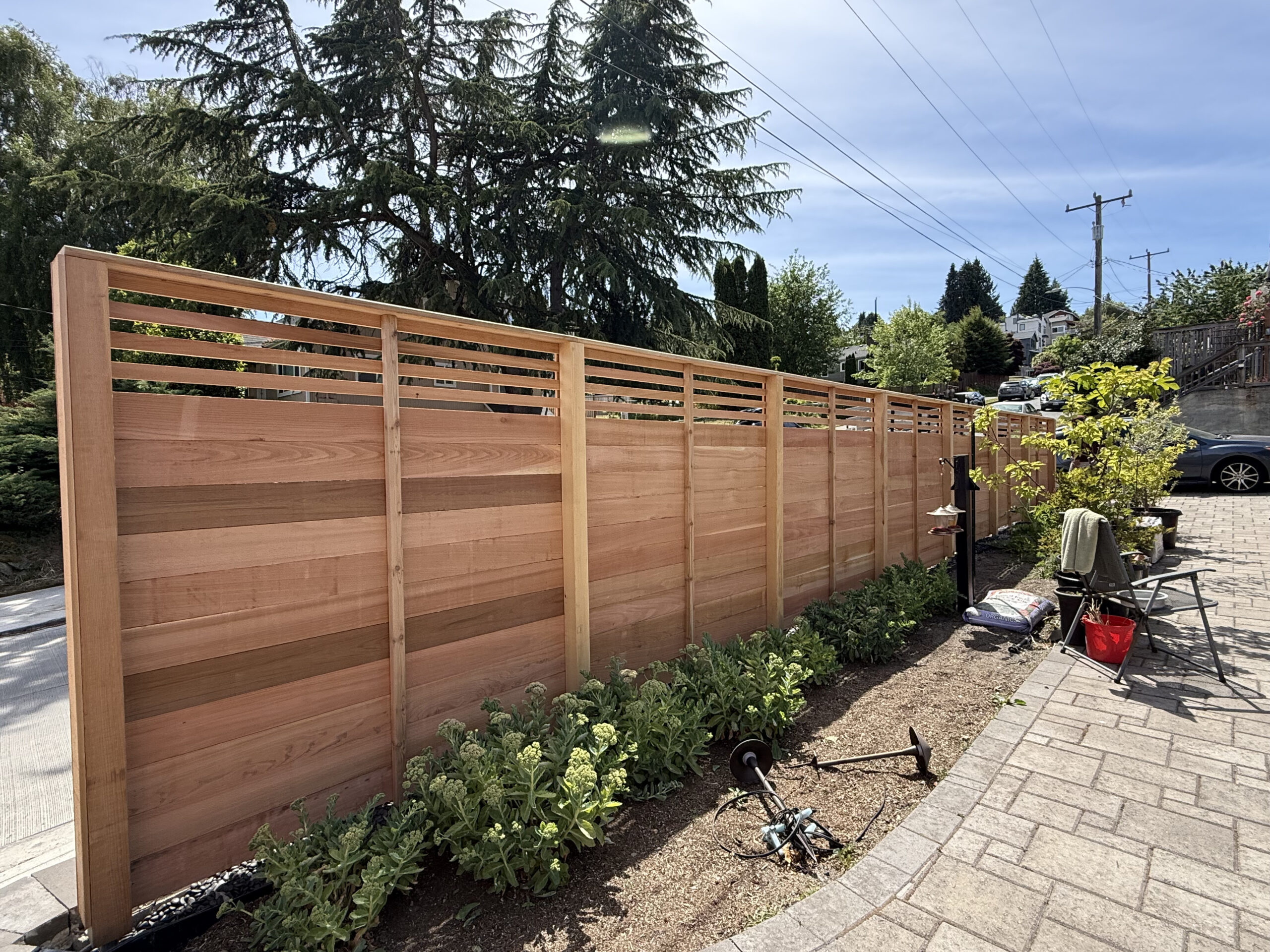
- Board spacing. Tight spacing creates full coverage that blocks sightlines completely for maximum privacy. A small gap, often a quarter-inch to half-inch between boards, lets in airflow and light while still screening the yard. Your spacing decides how private versus open the fence feels.
- Board width and style. Wider boards read modern and substantial, while narrower boards give a more detailed, layered fence style. Mixing widths is another way to make a horizontal wood fence feel custom, almost like a framed window onto your landscaping.
- Post caps and top trim. Finished post caps or a clean top rail sharpen the whole look and protect the post ends from standing water.
- Stain color. Leave it natural cedar, warm it up with a honey tone, or go dark and modern. Regular staining every two to three years keeps the color rich and adds moisture protection, and staining the fence annually is only needed in the harshest exposures.
- Gates and custom access. Matching gates, wider spans for RV access, and driveway openings can all be worked into the design instead of bolted on as an afterthought. Well-built gates hang square and swing clean for years.
- Pet-friendly details. A solid kickboard along the base closes the gap dogs like to nose under and keeps smaller pets contained.
Every one of these ties back to something you actually care about: privacy for the yard, containment for pets, curb appeal for the street. No cookie-cutter jobs here. We design around your property, your space, and your priorities.
Will a Backyard Fence Work on a Sloped Seattle Yard?
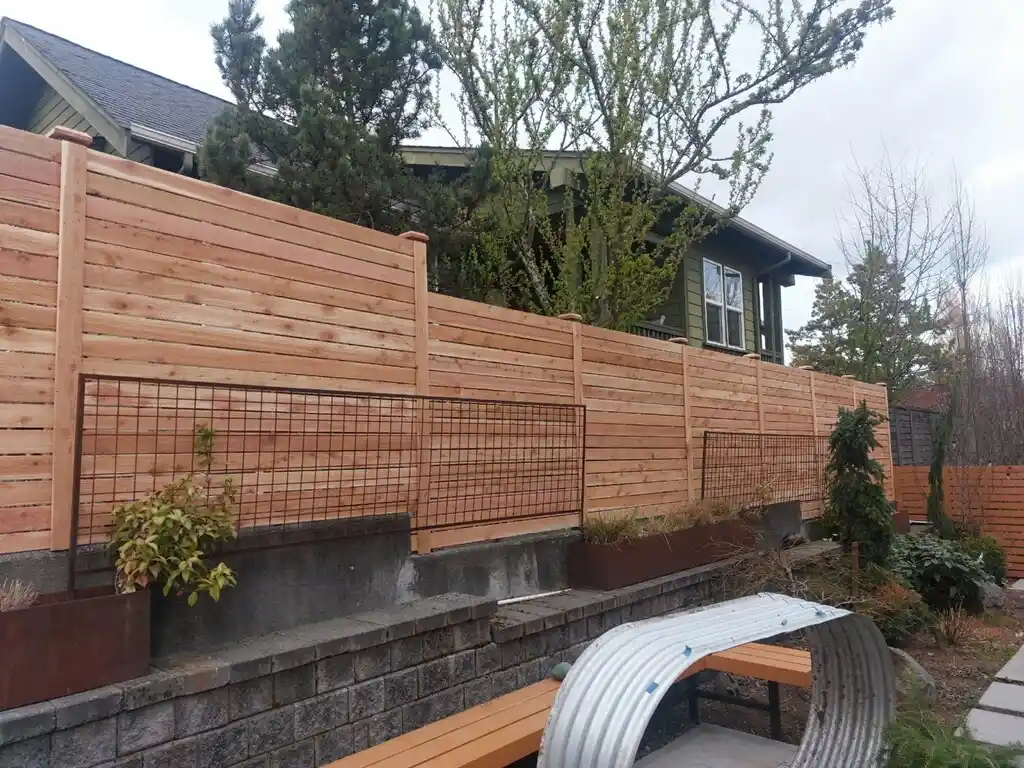
Yes. Slopes are normal here. West Seattle, the Eastside, Mercer Island, and plenty of King and Snohomish County lots have grade changes, and horizontal cedar handles them well with the right approach.
There are two common ways to follow a slope. A stepped layout keeps each section level and drops it down in tidy increments as the ground falls, which suits a crisp horizontal look and lets each run of boards stay dead level between posts. A racked or adjusted layout follows the grade more continuously. The right call depends on your terrain and the look you want.
Where the grade shifts sharply, a retaining wall may come into play alongside the fence, which affects both design and code. This is exactly the kind of thing we sort out during an on-site estimate. We love a challenge, and a sloped backyard fence is a good one. For more, see our ideas for fences on sloped Seattle yards.
Seattle Fence Rules to Know Before You Build
Before you settle on a fence height, it helps to know what Seattle allows. These come from Seattle SDCI, and they’re a starting point, not legal advice for your specific parcel.
| Rule | What Seattle SDCI says |
|---|---|
| Standard height limit | 6 feet in neighborhood residential and multifamily zones |
| Architectural features | Up to 2 additional feet allowed for arbors, trellises, and similar |
| Front / street-side setback | Limited to 4 feet |
| Construction permit | Generally not required for fences 8 feet or less, if no masonry or concrete over 6 feet and not in a flood-prone area |
| Sloping sites | Up to 8 feet allowed if the average height between posts is 6 feet |
| Fence over a retaining wall | Combined height limited to 9 feet 6 inches when the wall raises grade |
| Retaining wall / rockery permit | Permit threshold at 4 feet, if other exemption conditions are met |
Most residential fences top out at six feet, which is plenty for privacy on a typical lot. A couple more things to keep in mind. Fences near wetlands, steep slopes, or other environmentally critical areas can carry extra restrictions. And the city does not settle private property-line disputes, so if there’s any question about where your line falls, a survey may be worth it before you set your posts. Knowing your local neighborhood, terrain, and permitting requirements is part of what we bring to every project.
How to Choose the Right Fence Contractor in Seattle
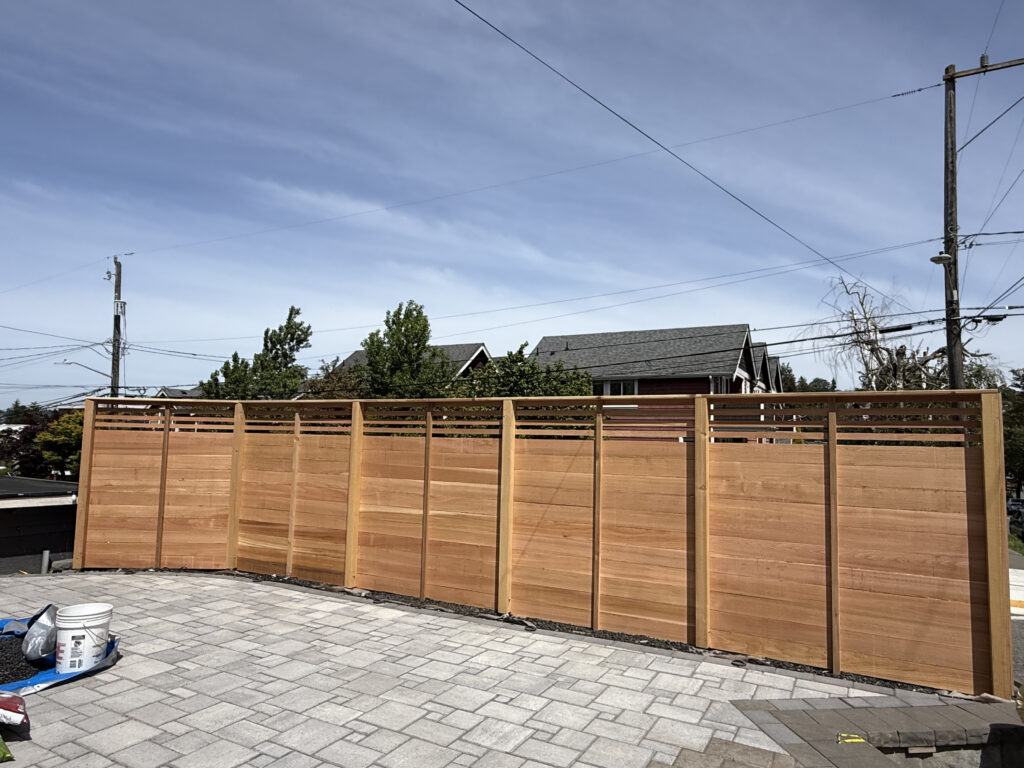
If a past contractor left you frustrated, you’re not alone, and you’re right to vet the next one carefully. Whether you’re replacing an old fence or tying into an existing fence, start with the basics you can verify.
In Washington, contractors must register with L&I, carry a surety bond, and hold general liability insurance. Bond amounts run $30,000 for general contractors and $15,000 for specialty contractors. Required liability coverage is either $200,000 public liability plus $50,000 property damage, or $250,000 combined. Contractors also have to show their registration number when they advertise or bid, and provide a Model Disclosure Statement on residential jobs of $1,000 or more. If a number isn’t on the estimate, ask for it.
Beyond the paperwork, here’s a short checklist:
- Licensed, bonded, and insured, with details you can confirm
- Clear communication and someone who actually answers
- A real on-site estimate, not a generic quote sight unseen
- Transparent pricing with no hidden fees, so the cost you’re quoted is the cost you pay
- A written warranty
- A final walkthrough and a yard left clean
A good contractor makes the process feel easy and cost effective, and they should be clear about the entire project from the first visit. You shouldn’t have to babysit the job, and you shouldn’t be surprised by the final cost, whether it’s quoted by the linear foot or as one number for the whole run.
Why Seattle Homeowners Choose DH Fence Pros
DH Fence Pros started in West Seattle in 2015, founded by lead builder Dan Hignite. What began as a small family operation has grown into a trusted Greater Seattle area fencing team, backed by 25+ years of combined crew experience. We’re a tight professional crew, not a franchise, and Dan answers his phone.
We build custom cedar, horizontal, hogwire, and aluminum fences, plus driveway gates, retaining walls, and fence staining. Everything is designed for Seattle’s climate, because that’s the only weather our fences have to survive. From the posts and frame to the last board, we build with the precision this climate demands, and we’re proud of the finished product every time.
We’re fully licensed, bonded, and insured, and our work carries a 36-month installation warranty. Pricing is transparent with no hidden fees, and final payment isn’t due until the work is complete and you’ve walked the finished fence with us. Financing is available through Acorn if that helps your timeline.
No cookie-cutter jobs here. We serve Seattle, Shoreline, Edmonds, Lynnwood, Mountlake Terrace, Bellevue, and nearby King and Snohomish County areas, and we treat every yard like it’s the one people will see.
Get a Free Estimate for Your Horizontal Cedar Fence and Better Curb Appeal
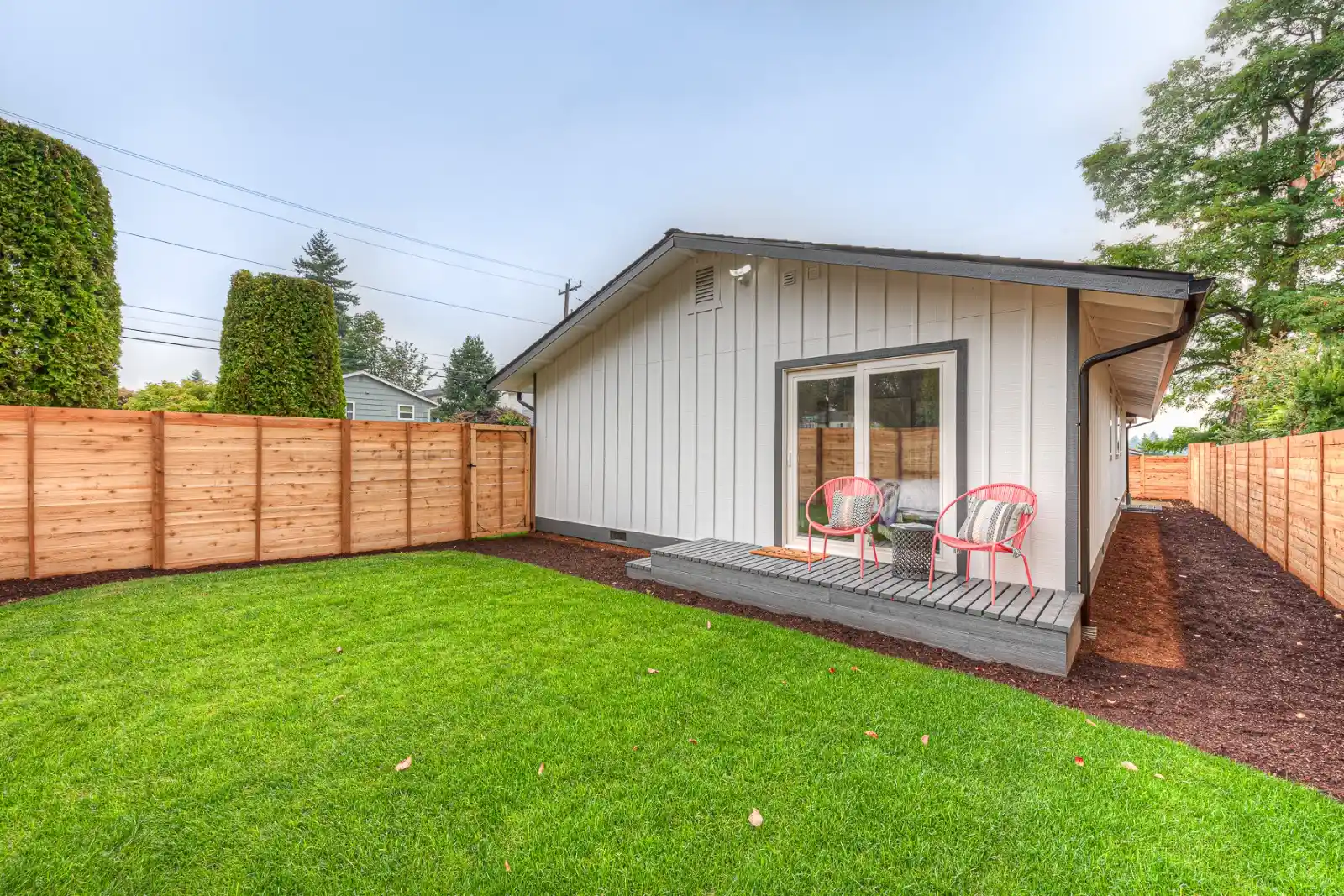
Ready to see what a horizontal cedar fence would look like on your property? Our on-site estimate is a quick visit, about 30 minutes, where we look at your yard, talk through your goals and fence style, and give you an honest, transparent cost with no surprises.
Request a free estimate, book your on-site visit, or just call or text us at (206) 330-6709, whichever’s easiest for you. We’re available Monday through Saturday, 8:00am to 8:00pm.
Serious About Service. Passionate About Fences.
Frequently Asked Questions About Horizontal Cedar Fences
Are horizontal cedar fences good for privacy?
Yes. Tight board spacing creates a solid privacy barrier that blocks sightlines into your yard. Leave a small gap between the boards and you trade a little privacy for airflow and light, so the right spacing depends on what you want.
Do horizontal cedar fences hold up in Seattle weather?
They do when built correctly. Cedar naturally resists moisture and decay, and with proper spacing, drainage, and post depth, the fence stands up to our roughly 39 inches of annual rain. It isn’t maintenance-free, but it’s well suited to the Pacific Northwest.
Do horizontal fence boards sag or warp?
Only when they’re under-supported or poorly built. Proper framing, mid-span backing, solid fastening to the posts, and quality cedar keep the boards straight for the long haul. Sagging is a construction problem, not a cedar problem.
How tall can a horizontal fence be in Seattle?
In most neighborhood residential zones, Seattle SDCI limits fences to 6 feet, with front and street-side setbacks capped at 4 feet. A construction permit generally isn’t required for fences 8 feet or less under certain conditions. Always check the rules for your specific property.
How much does a horizontal cedar fence cost?
Cost depends on the length of the run, the height, board spacing, gates, and whether your yard has slopes or a retaining wall in play. Because every property is different, we don’t post a flat price. We give you a clear, transparent cost during a free on-site estimate so there are no surprises.
Can a horizontal cedar fence be built for dogs or pets?
Absolutely. A solid kickboard along the base closes the gap pets like to dig or squeeze under, and tight spacing keeps smaller animals contained. We design pet-friendly details right into the fence.