

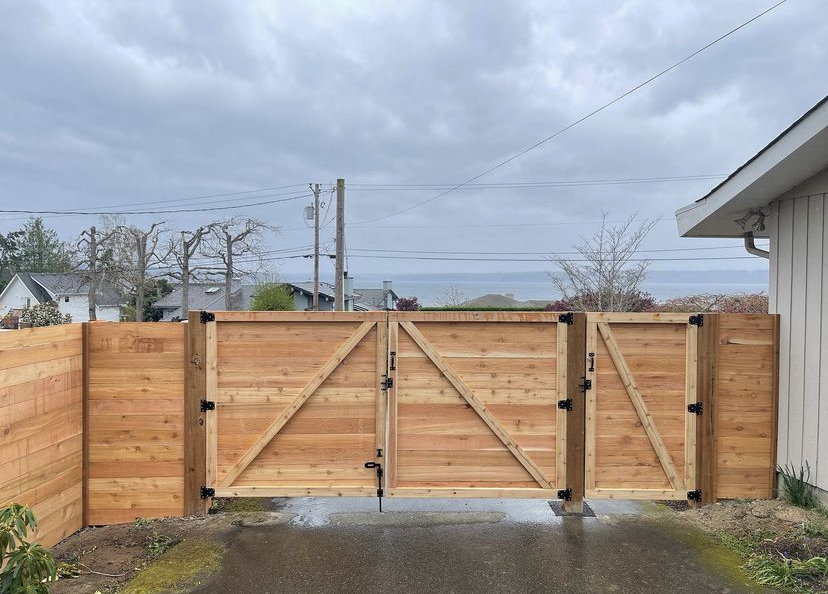
Key Takeaway
For most Seattle homeowners who use their driveway daily, an automatic driveway gate is the better choice between automatic vs. manual driveway gates, offering keypad, remote, and app access without stepping into the rain. Manual gates cost roughly $100 a year to maintain versus $200 to $500 for automatic systems, making them smarter for gates used only occasionally. Slope, right-of-way rules, and UL 325 safety requirements often decide which option is even feasible on your specific lot.
Automatic vs Manual Driveway Gates: The Short Answer for Seattle Homeowners
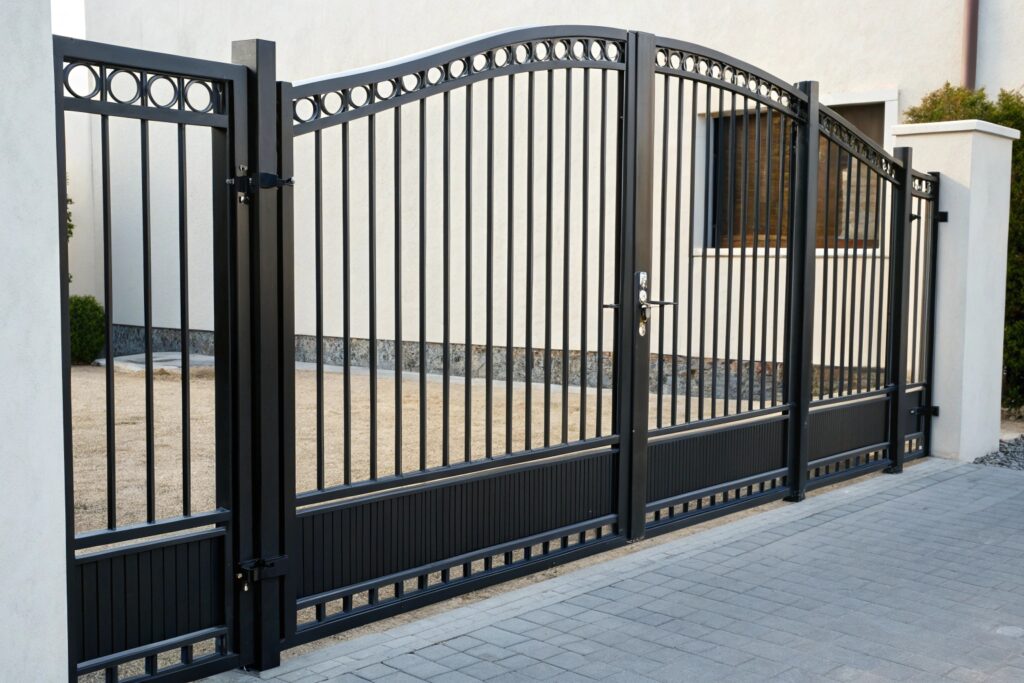
If you use your driveway every day, want to open the gate from your car, and would rather not step out into the rain on a dark winter evening, an automatic driveway gate is the better fit. If your gate gets occasional use and you don’t mind opening and locking it by hand, a manual gate keeps things simple with fewer powered parts to worry about.
You’re probably comparing options before you commit, which is exactly the right time to think this through. The real answer for your property depends on how your driveway is shaped, how steep it is, whether power outages are a concern, what safety equipment the gate systems need, and a few Seattle rules that most homeowners don’t know to check. Choosing the right gate comes down to those details, so let’s walk through them so you can decide with confidence.
What’s the Difference Between an Automatic and Manual Driveway Gate?
An automatic driveway gate uses a motor (the operator, often called a gate opener) paired with some way to trigger it: remote controls, a keypad, an app, a sensor, or an intercom. You press a button or drive up, and the gate does the work. A manual driveway gate is opened and closed by hand using hinges, latches, locks, and sometimes a drop rod to hold it in place.
The practical difference comes down to power and parts. An automatic gate system depends on electricity and needs a licensed electrician to wire the operator correctly. A manual gate is always operable no matter what the power is doing. Automatic gates also bring safety devices into the picture, which we’ll cover below, because a motorized gate that can move on its own needs to move safely.
Quick Comparison: Automatic vs Manual Driveway Gates
| Factor | Automatic Gate | Manual Gate |
|---|---|---|
| Best for | Daily use, remote access, controlled entry | Occasional use, simpler operation |
| How it opens | Motor plus remote controls, keypad, app, sensor, or intercom | By hand, using hinges and latches |
| Convenience | High; stay in the car | Lower; get out and open it |
| Security & access control | Keypads, cameras, authorized-user codes | Locks and latches only |
| Power needs | Requires electrical supply and wiring | None; always operable |
| Typical maintenance costs | Around $200 to $500 a year | Around $100 a year; low maintenance |
| Weather considerations | Operator, sensors, and alignment must handle moisture | Hinges, wood, and alignment must handle moisture |
| Safety considerations | Entrapment protection and motion sensors required | Fewer moving hazards |
| Best Seattle use case | Busy driveway, rainy commutes, delivery control | Quiet lot, short driveway, budget-conscious build |
Timelines vary too. A wood manual gate can go in around two days, while most gate installations run two to seven days depending on scope. A metal-framed gate can take two to four weeks for fabrication before it ever reaches your driveway.
Choose an Automatic Driveway Gate If…
Automation earns its keep when the gate is part of your daily routine and when you want real control over who comes and goes.
- You use the driveway every day and don’t want to stop, get out, and open it each time.
- You’d rather stay dry and warm in the car during rain, wind, or a dark winter evening.
- You want controlled access for guests, pets, kids, delivery drivers, or commercial traffic.
- You want keypad, remote controls, intercom, camera, or app options to limit entry to authorized users and deter anyone who shouldn’t be there.
- You’d like motion sensors and the option to tie the gate into a smart-home setup down the road.
Automatic driveway gates also give your entrance a polished, finished look that many homeowners want for security and curb appeal, and a well-designed entrance can add to property value. Residential driveway gates like these let property owners control the entry while keeping the front of the home looking sharp. When the site allows for safe, compliant automation, it’s a strong choice.
The Trade-Offs of Automatic Gates
We believe in being straight with you. Automatic gates add electrical components, sensors, and a dependence on power. More parts means more that can eventually need service, and repairs on a motorized system cost more than fixing a simple hinge. You’ll also want a licensed electrician handling the wiring, and maintenance costs run higher than a manual gate. Automated gates also carry higher operating costs over time, though the convenience is worth it for daily use. None of that is a dealbreaker. It’s just worth knowing before you decide.
Choose a Manual Driveway Gate If…
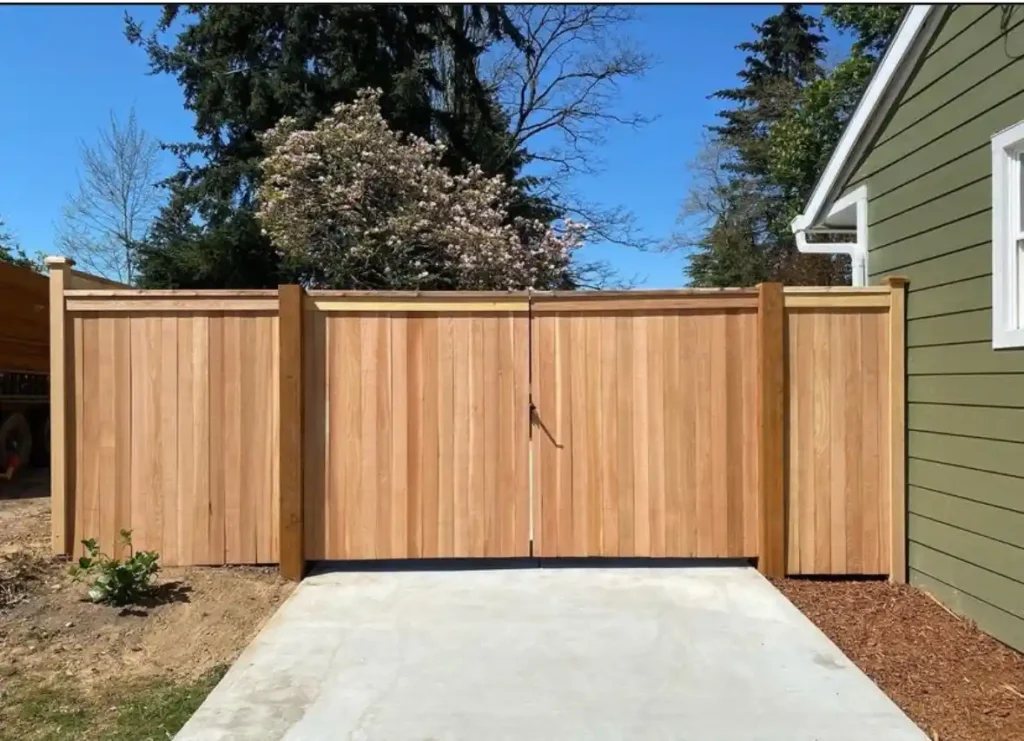
A manual gate is the simpler, low maintenance path, and for the right property it’s the smarter one. It also carries a lower initial cost than a powered setup.
- The gate only gets used now and then, not multiple times a day.
- You prefer a system with fewer powered components and less to maintain.
- You’re comfortable opening, closing, and locking the manual gate by hand.
- Your driveway is short or sees light traffic.
- You want a solid, custom-built gate now and might add automation later.
Manual driveway gates are more approachable on budget and low maintenance, and they keep working regardless of any power issues. Yearly upkeep tends to land around $100, mostly minor attention rather than technical service.
A Manual Gate Still Has to Be Built Right
Hand-operated doesn’t mean simple to build. A manual gate needs excellent posts, quality hinges, a solid latch, and careful alignment so it stays square through Pacific Northwest moisture. Wood gates need hinge lubrication and rust prevention on the hardware over time, and the right gate material makes all the difference in how long that hardware lasts. Be honest about the physical effort too: heavy gates are real work to swing open on a wet or dark morning, so gate size and weight matter as much as looks.
Seattle Property Factors That Matter More Than Most Homeowners Realize
This is where knowing your neighborhood pays off. A gate that works on a flat lot in Green Lake behaves very differently on a hillside in West Seattle, Queen Anne, Capitol Hill, or Magnolia. Dan and our crew spend a lot of time solving exactly these puzzles, and the site details below usually decide the design before the material ever does.
Slope and Grade Changes
Seattle has no shortage of steep driveways, and slope changes everything. Swing gates can bind or drag as the ground rises across the arc, so they need clearance planned around the grade. Sliding gates avoid that arc entirely, which makes automatic sliding gates a good fit for tight spaces and sloped driveways, but they need clear run space to one side. A double swing gate can split a wide span into two smaller, easier-moving leaves, while single swing gates work well on narrower openings. Bi fold gates are another option where side run space is limited. On the toughest lots, custom hardware is what makes the gate work.
Sidewalks, Alleys, and the Public Right-of-Way
On tight urban lots where the driveway meets a sidewalk or alley, swing direction matters legally, not just practically. The Seattle Building Code is direct about it: no door or gate in any position may project over public property. That means your gate can’t swing out over the sidewalk, planting strip, or alley. SDOT also discourages private structures in the public right-of-way and wants them kept on private property. We plan the swing (or choose a slider) so your gate stays entirely on your side of the line.
Mature Landscaping, Narrow Lots, and Shared Driveways
Established plantings and narrow lots limit where the gate can travel and where an operator can sit, so both need room designed in from the start. Shared driveways, multifamily buildings, and commercial access can trigger emergency-access review, which we cover in the fire section below. And don’t forget daily life: pets, kids, RV access, and deliveries all shape how the gate should function, not just how it looks.
Automatic Gate Safety Features and Access Control Every Homeowner Should Know
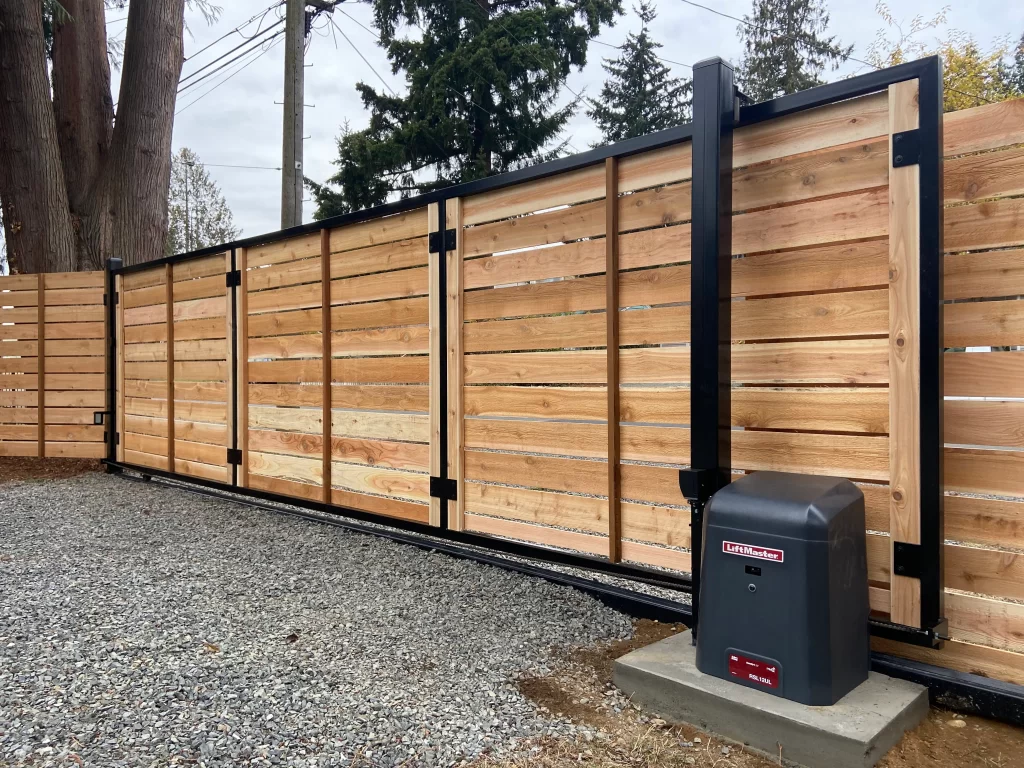
Most gate articles mention “sensors” and move on. Here’s what actually matters, in plain terms. Two standards govern automated vehicular gates. UL 325 covers the safety of the gate operator itself. ASTM F2200 covers how the gate is built for automated vehicular use, and it sorts gates into classes: Class I is the residential class, meaning a home or a building with one to four single-family dwellings. The 2024 building and fire codes require installed gate operators to be listed to UL 325.
An entrapment zone is any spot where a moving gate could trap a person, a pet, or an object. Under UL 325, each entrapment zone needs at least two independent entrapment protection means. In practice that’s equipment like photo eyes, motion detectors, and sensing edges that stop or reverse the gate. These safety features aren’t optional upgrades when the system requires them; they’re what keeps a delivery driver, a kid, or a dog from getting hurt. DASMA, the industry group for these systems, tells homeowners to confirm the operator is listed to UL 325 and the gate complies with ASTM F2200.
Beyond safety, automation opens the door to enhanced security and advanced access control that address common security concerns: keypads with keyless entry and authorized-user codes, cameras at the entry, alarm systems, and app-based remote monitoring that lets you see and manage the gate remotely. Remote access and automatic operation are the tools that let you decide exactly who gets past your entrance, and that remote operation is a real draw for busy households. One more thing: a driveway gate is for vehicles, not foot traffic. Plan pedestrian access separately so people aren’t walking through the path of a motorized gate. After we install gates, the safety sensors and remote controls should be tested to confirm everything stops and reverses the way it should.
What Happens to an Automatic Gate During a Power Outage?
A manual gate keeps working by hand no matter what the grid is doing. An automatic gate should be designed with a manual release, a battery backup, or both, so you’re never stuck behind your own gate. This matters in Seattle, where winter windstorms cause power outages more often than snow ever does. Seattle City Light advises planning ahead for anything in your home that relies on electricity, and your driveway gate belongs on that list if you’d need to leave during power outages. Maintaining security during an outage is part of the design too. We won’t promise a specific number of days on backup power, because that depends on the equipment. Where fire-access rules apply, the code requires electric gates to allow manual operation by one person plus an approved emergency opening method, which we build in.
Do You Need a Permit for a Driveway Gate in Seattle?
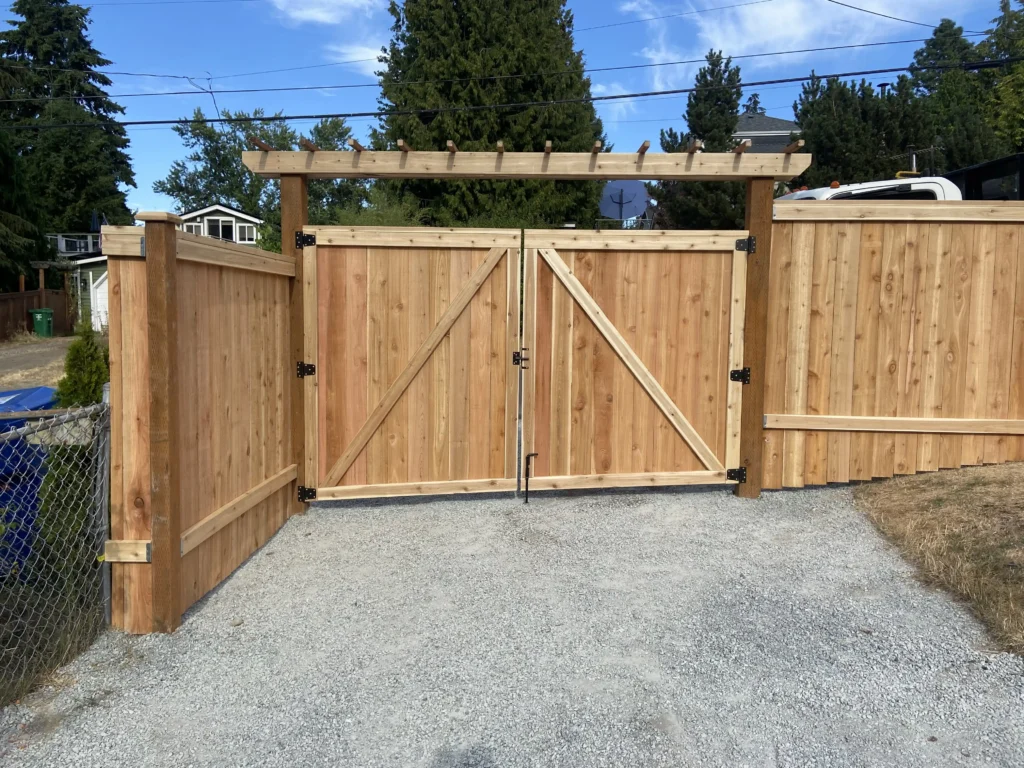
Many residential gate projects are straightforward, but the details decide it, so it’s worth checking before work starts. Here’s the shape of Seattle’s rules through SDCI.
- No construction permit is needed for a fence or gate 8 feet or less, as long as it has no masonry or concrete elements over 6 feet.
- The general height limit in residential zones is 6 feet, plus up to 2 feet of architectural features like an arbor or trellis.
- In a front or street-side setback, the limit drops to 4 feet.
- On a sloping site, a fence can reach 8 feet if the average height between posts is 6 feet.
- Flood-prone areas have their own requirements.
Automation adds an electrical layer. Wiring for a gate opener may call for a Stand-Alone Low-Voltage electrical permit, and any electrical work must be done by a properly licensed professional under Washington L&I rules. The exact scope depends on your power source and wiring. If the gate affects a shared or long driveway, or multifamily or commercial access, a fire-access review may apply. The safest move is to review your specific site before anything gets built, which we handle during the estimate.
Materials and Design: Choosing a Gate Material Built for Pacific Northwest Weather
Snow isn’t the real test here. Moisture is. Seattle averages 39.34 inches of rain across about 156 wet days a year, with only around 6.3 inches of snow. That steady wetness is what warps a poorly built gate, seizes cheap hardware, and pulls a gate out of square over a few seasons. A gate that stays true through those wet months was designed for them from the start.
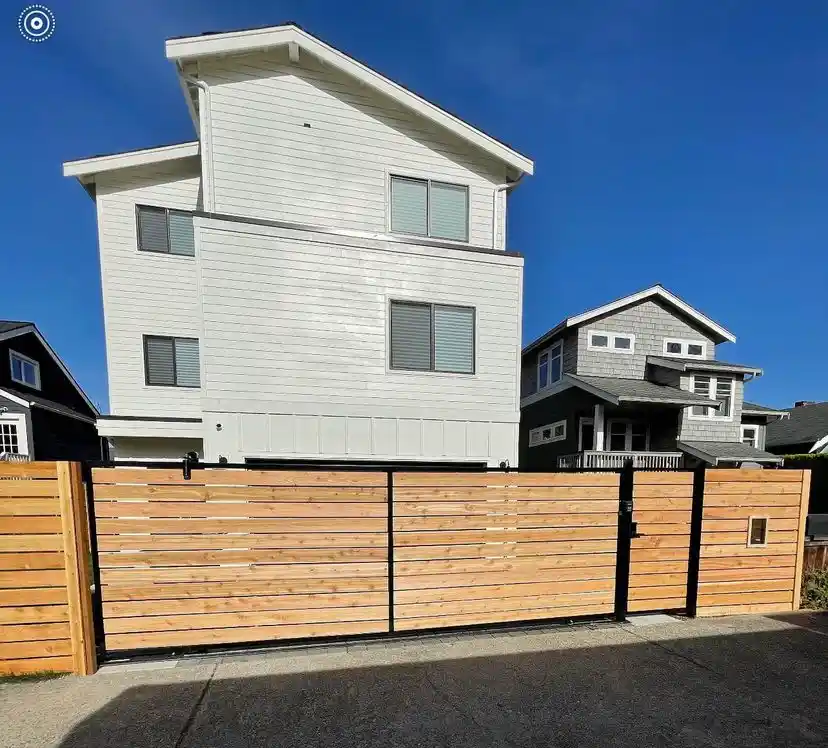
We build custom cedar driveway gates, horizontal cedar designs, and aluminum options, all chosen for how they’ll hold up here. Your gate type and material shape both durability and upkeep: weather-resistant cedar wood panels, quality staining and sealing where it belongs, durable posts set right, and hinges and latches that won’t corrode. Aluminum is a naturally low maintenance choice that resists rust in our wet climate. Wrought iron gates bring a classic look, and any metal gates with an iron frame need the right coating to fight corrosion here. Good design also means placing the operator where water drains away from the electrical components and setting the gate so alignment holds when the wood swells and shrinks with the seasons. Wrought iron, chain link, and other metals have their place as material context, but the choice always follows the property, not a catalog. Done right, custom gates deliver privacy, security, and curb appeal at once, and a well-built entrance supports your property value over time. No cookie-cutter jobs here; Dan and the crew size every custom driveway gate to the driveway it’s guarding.
Maintenance Considerations: What to Expect From Each Gate Type
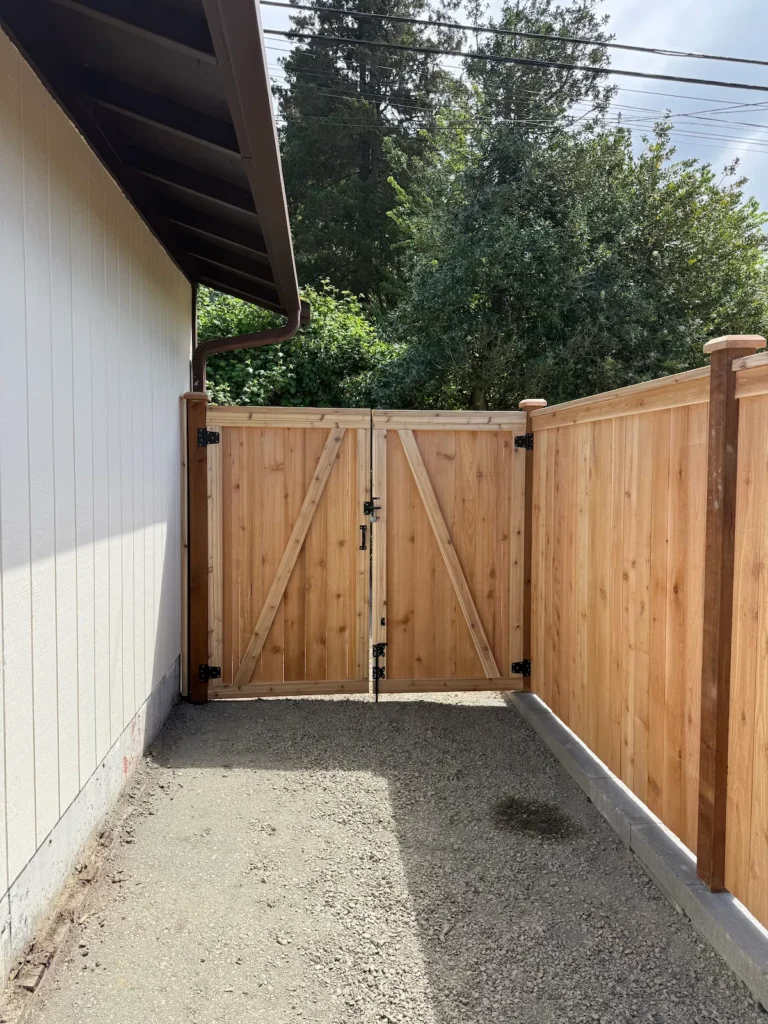
Manual gate upkeep is light and mostly hands-on. Regular maintenance keeps it swinging clean:
- Check hinges and lubricate them so the gate swings clean.
- Watch for sagging and keep the latch aligned.
- Keep the wood protected and prevent rust on the hardware.
- Keep the swing path clear.
Automatic gate upkeep includes all of that, plus ongoing maintenance of the powered system:
- Motor and gate opener checks.
- Testing the motion sensors and safety sensors so they still stop and reverse.
- Access controls, remote controls, power, and battery backup.
Most automatic gates need this occasional maintenance to stay reliable, and many automatic gates run smoothly for years with proper maintenance. Expect around $100 a year for a manual gate and roughly $200 to $500 for an automatic one, with higher repair costs when a powered component fails. Anything involving the electrical components or safety systems is best handled by a professional gate company.
How DH Fence Pros Helps You Choose
We started in West Seattle in 2015, and Dan Hignite still leads the crew. We’re fully licensed, bonded, and insured, with 25+ years of combined hands-on experience across the team. When you call, you get straight answers about what your driveway needs, transparent pricing with no hidden fees, and a 36-month installation warranty behind the work. From the gate base to the final installation, we handle the slope, the permitting questions, the whole gate installation process, the wiring coordination, and the safety details so you don’t have to. Our job is to make this easy and to leave your yard clean when we’re done.
Frequently Asked Questions
Is an automatic driveway gate worth it for a Seattle home?
If you use the driveway daily and want to stay in the car during our long rainy season, yes. For a gate that only opens occasionally, a manual gate is often the smarter, low maintenance choice.
What is the biggest downside of an automatic driveway gate?
It depends on power and has more parts, so repairs cost more and it needs licensed electrical work plus annual servicing of the gate opener and safety sensors.
Can I automate a manual driveway gate later?
Often, yes, if the gate is built with automation in mind from the start. We can design manual driveway gates now with the posts, sizing, and layout ready for a gate opener down the road.
Are swing gates or a sliding gate better for a sloped driveway?
A sliding gate usually wins on a slope because it avoids the arc swing gates need, though it requires clear side run space. On Seattle’s steeper lots with frequent traffic, we assess both on-site.
Do I need a permit for a driveway gate in Seattle?
Many fences and gates 8 feet or less don’t need a construction permit, but automatic gates add electrical and safety considerations, and setbacks or right-of-way can matter. We review your specific site before work begins.
Get the Right Gate for Your Driveway
Want help deciding between automatic and manual driveway gates? Schedule a free on-site estimate with DH Fence Pros. We’ll look at your driveway, slope, access needs, and design goals, then walk you through the right gate solution for your property. Call or text us at (206) 330-6709, whichever’s easiest for you.
Serious About Service. Passionate About Fences.